
Delhi is a city built on contrast – the corporate hustle of Connaught Place, the academic energy of North Campus, the family-first culture of Rohini and Dwarka, the quieter professional pockets of South Delhi and Vasant Kunj. Across all of these, one pattern shows up again and again in my practice: couples and families who live together, eat together, manage the same home — and still feel like strangers by 9 PM.
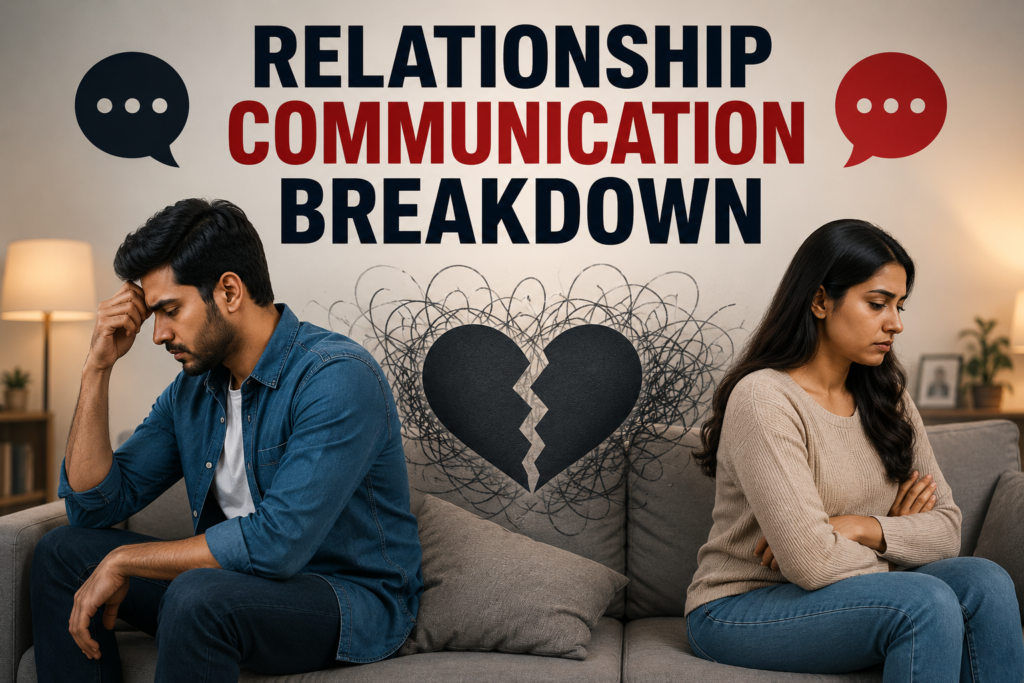
If conversations with your partner keep turning into arguments, or worse, into silence, you’re not imagining it. This is a relationship communication breakdown, and it’s one of the most common reasons people in Delhi seek relationship counseling.
What a Communication Breakdown Actually Looks Like
Every couple argues — that’s normal. A breakdown is different. It’s when conversations stop being about solving the problem and start being about winning it, or avoiding it altogether.
In sessions, this usually shows up as one (or more) of these patterns:
1. The blame-and-defend loop A small comment — “you forgot to pay the electricity bill” — turns into “you never think about this house.” Both partners switch into defense mode, and the actual issue never gets addressed.
2. Stonewalling One partner goes quiet, leaves the room, or simply stops responding. It feels like it ends the fight, but it actually starves the relationship of the engagement it needs to repair.
3. Scorekeeping Old arguments resurface in new ones — “this is just like what happened in 2022” — because the original hurt was never actually resolved, just paused.
4. Conversational avoidance Finances, in-laws, career plans, even intimacy — these topics quietly disappear from conversation because both partners expect them to end in a fight. What’s left is logistics: bills, schedules, groceries. Partners start functioning more like co-managers of a household than a couple.
Why This Shows Up So Often in Delhi Specifically
A few things about life in Delhi NCR make communication breakdowns more likely, or make existing ones worse:
- Commute and work fatigue. A couple working in Gurgaon and Noida respectively, commuting 1.5–2 hours each way, has maybe 45 minutes of actual awake time together on a weekday. There’s very little bandwidth left for a difficult conversation.
- Joint family dynamics. In neighborhoods like Rohini, Dwarka, and parts of West Delhi, many couples live with or very close to parents. Decisions that would be private in a nuclear household — how to spend, how to parent, how to spend Diwali — become three-way negotiations, and disagreements between partners often get absorbed (or amplified) by family expectations.
- Social comparison pressure. Delhi’s social circuit — weddings, kitty parties, WhatsApp groups — adds a layer of “how do we look as a couple” that can make partners avoid conflict in front of others and let it build up in private.
- First-generation career pressure, especially in South Delhi and Vasant Kunj households where both partners are demonstrating professional success to family, which can leave emotional needs at home unspoken.
None of these are unique to Delhi, but the combination — long commutes, joint-family proximity, and high social visibility — is a specific local pressure cooker.
Healthy vs. Breakdown Communication
| Healthy Communication | Communication Breakdown | |
|---|---|---|
| Goal | Understand each other, find a solution | Win the argument, prove a point |
| Language | “I feel…” statements | “You always / you never” statements |
| When overwhelmed | Pause, come back to it calmly | Escalate until someone shuts down or explodes |
| Outcome | Both feel heard | Both feel defensive or unseen |
How Relationship Counseling Actually Helps
Counseling isn’t about deciding who’s “right.” A structured, neutral process does three specific things:
1. Creates a space where both people can speak without it turning into a fight. A counselor manages the pace of the conversation so both partners can actually finish a sentence.
2. Identifies what the fight is really about. Most recurring arguments about chores, money, or in-laws are proxies for an underlying need — feeling appreciated, feeling secure, feeling like a priority. Counseling helps name that need directly instead of fighting about its surface symptom.
3. Builds specific tools, not just insight. Depending on the approach used, this can include structured communication exercises (like the Gottman Method’s “soft startup” technique, which trains partners to raise an issue without criticism or contempt), boundary-setting frameworks for in-law conflicts, and repair strategies to use right after an argument instead of days later.
Individual Counseling, If Your Partner Won’t Come
Couples counseling works best when both partners attend, but it’s not a requirement to start. Working one-on-one with a counselor still helps you change how you respond in the pattern, set clearer boundaries, and often shifts the dynamic even if your partner never sits in the room.
Online vs. In-Person Sessions
Given Delhi’s traffic and commute realities, many practices – including ours – offer both in-person sessions and secure online video sessions. Online sessions are often a practical starting point for couples juggling long work hours, especially when one partner is more hesitant to begin.