
How to Stop Overthinking and Anxiety: Practical Ways to Calm Your Mind
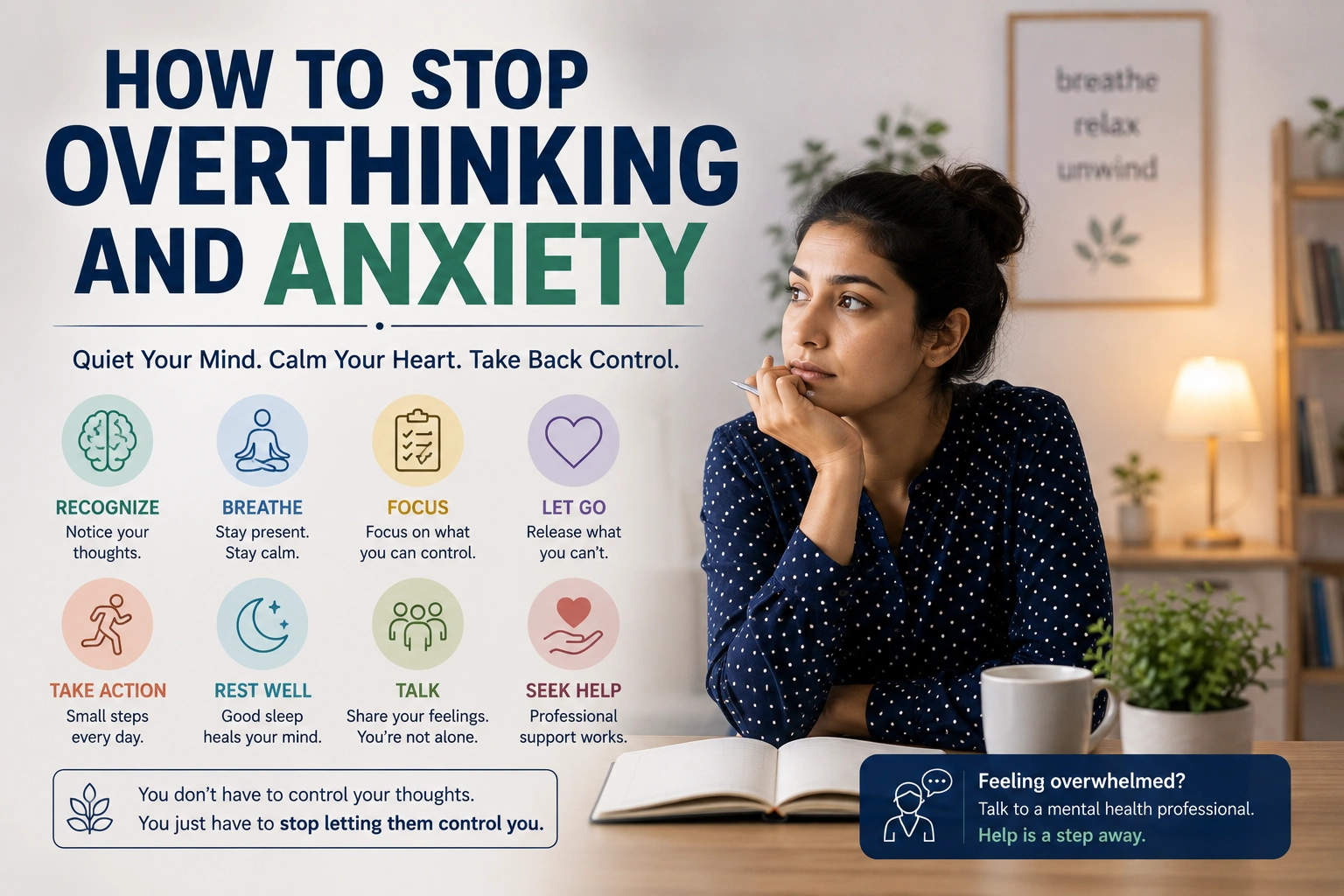
Have you ever replayed the same conversation in your head again and again?
Maybe you keep thinking about something you said yesterday. Or you worry about what might happen tomorrow. Sometimes, even when everything seems fine, your mind keeps creating one “what if” after another.
“What if something goes wrong?”
“What if I made a mistake?”
“What will happen in the future?”
“What if people judge me?”
This constant thinking can become exhausting.
Overthinking and anxiety often go together. When you’re anxious, your brain may keep searching for answers, certainty, or ways to prevent something bad from happening. Unfortunately, thinking about the same problem repeatedly doesn’t always solve it. Instead, it can make you feel even more worried.
The good news is that overthinking can be managed, and learning how to respond differently to anxious thoughts can make a real difference.
In this article, we’ll discuss why overthinking happens, how it is connected with anxiety, practical ways to calm your mind, and when professional anxiety counseling may be helpful.
What Is Overthinking?
Overthinking generally refers to spending excessive mental energy analyzing, replaying, or worrying about situations, decisions, or possible outcomes.
For example, you might:
- Replay an old conversation
- Worry about something that hasn’t happened
- Keep analyzing a decision
- Imagine worst-case scenarios
- Constantly seek reassurance
- Think about what other people think of you
- Find it difficult to “switch off” your mind
Thinking about a problem can sometimes be useful.
The problem begins when thinking becomes repetitive but doesn’t lead to a solution.
You may end up asking the same questions repeatedly without feeling any more certain.
Why Do Anxiety and Overthinking Happen Together?
Anxiety often creates a strong desire for certainty.
When something feels uncertain, your mind may try to solve every possible outcome.
For example:
“What if I fail?”
Then your mind asks:
“What can I do to make sure I don’t fail?”
Then:
“But what if something unexpected happens?”
And suddenly, you’ve spent an hour thinking about a situation that hasn’t even happened.
This is one reason anxiety can fuel overthinking.
The more you try to eliminate uncertainty through thinking, the more possibilities your mind may generate.
10 Ways to Stop Overthinking and Manage Anxiety
There is no single technique that works for everyone. However, these strategies can help you develop a healthier relationship with anxious thoughts.
1. Notice When You’re Overthinking
The first step is simply recognizing what is happening.
Instead of immediately following every thought, pause and ask:
“Am I solving a problem right now, or am I repeating the same worry?”
This small distinction can be surprisingly useful.
Problem-solving usually moves you toward an action.
Overthinking often keeps you going around in circles.
Recognizing the difference can help you step out of the cycle.
2. Separate What You Can Control From What You Can’t
Anxiety often focuses on things that are outside your control.
You cannot completely control what other people think, what happens tomorrow, other people’s decisions, unexpected events, or everything that happens in the future.
But you can often control how you prepare, what actions you take today, how you communicate, how you respond to difficult situations, and whether you ask for help.
When you notice yourself worrying about something outside your control, ask: “Is there something I can realistically do about this right now?”
If the answer is yes, identify one small action. If the answer is no, gently bring your attention back to the present.
3. Don’t Treat Every Thought as a Fact
One of the most important things to remember is: A thought is not necessarily a fact.
When anxiety is high, thoughts can feel extremely convincing.
Instead of immediately accepting that thought, try asking:
- What evidence do I have?
- Is there another possible explanation?
- Am I assuming the worst?
- Would I think the same thing if I were feeling calm?
- Am I predicting the future?
You don’t need to force yourself to think positively. The goal is to develop a more balanced perspective.
4. Give Yourself a Break From Constant Reassurance
When you’re anxious, you may repeatedly search Google, ask people for reassurance, check things again, or revisit the same decision.
It may provide temporary relief.
But repeatedly seeking reassurance can sometimes keep the anxiety cycle going.
Instead of trying to achieve 100% certainty, practice accepting that some uncertainty is a normal part of life. You don’t need an answer to every “what if” before moving forward.
5. Focus on the Present Moment
Overthinking often takes your mind into the past or future.
Grounding yourself in the present can help interrupt this cycle.
Try noticing what you can see, hear, feel, your breathing, and what you’re doing right now.
Even a few minutes of mindful attention can help you reconnect with the present.
6. Write Your Thoughts Down
When everything is happening inside your head, worries can feel bigger and more confusing. Writing them down can create some mental distance.
Try making two columns: What I’m worried about vs. What I can do about it.
This turns vague worry into something more concrete. You may discover that some worries require action, while others are simply possibilities your mind is imagining.
7. Take Care of Your Sleep and Routine
Overthinking can make it difficult to sleep, and poor sleep can make emotional regulation more difficult the next day.
Try to maintain a consistent routine around sleep, meals, physical activity, work or study, relaxation, and screen time.
If your mind becomes particularly active at night, avoid turning your bed into a place where you spend hours analyzing problems.

8. Avoid Fighting Every Anxious Thought
Sometimes we make anxiety worse by trying desperately to get rid of it. You may think: “I shouldn’t feel anxious.” Then you become anxious about being anxious.
Instead, try acknowledging the experience: “I’m feeling anxious right now. I don’t have to solve everything immediately.”
Accepting that a difficult emotion is present doesn’t mean giving up. It means you don’t have to fight every thought that appears in your mind.
9. Do Something That Brings You Back Into Your Day
When you’re stuck in your head, a small physical activity can help shift your attention—such as taking a walk, stretching, talking to someone you trust, listening to music, or working on a simple task.
The goal isn’t to run away from your thoughts, but to remind your brain that there is more happening in the present moment than the worry you’re currently experiencing.
10. Talk to a Mental Health Professional
If you’ve tried managing your anxiety on your own but continue to feel overwhelmed, professional support may be worth considering.
A mental health counselor can help you understand why you overthink, what triggers your anxiety, and how therapeutic approaches like CBT can help.
When Is Overthinking a Mental Health Problem?
Everyone overthinks occasionally. It becomes more concerning when it starts interfering with your everyday life.
Consider speaking with a mental health professional if overthinking or anxiety happens very frequently, feels difficult to control, interferes with sleep, affects work or studies, causes relationship problems, makes decision-making difficult, causes significant distress, leads you to avoid normal activities, or is accompanied by frequent panic-like experiences.
Can Anxiety Counseling Help With Overthinking?
Yes, counseling can help people understand the connection between anxiety, repetitive thinking, emotions, and behavior.
During anxiety counseling, you may discuss situations that trigger overthinking and learn to recognize patterns in your thoughts. Instead of trying to control every thought, therapy can help you develop healthier ways of responding to thoughts when they appear.
Can Online Counseling Help With Anxiety and Overthinking?
Yes, online anxiety counseling can be a convenient option if you prefer to speak with a mental health professional from home.
It can be especially useful if you live in another city, have a busy schedule, prefer online sessions, find travelling difficult, or feel more comfortable in your own environment.

Online Anxiety Counseling With Vaibhav Mishra
If constant worrying, overthinking, stress, or anxiety is making everyday life difficult, online counseling can give you a convenient way to seek professional support.
At Vaibhav Mishra, online mental health counseling focuses on understanding your individual concerns and working toward practical strategies for managing emotional difficulties.
You can discuss concerns related to anxiety, overthinking, excessive worrying, stress, panic-related concerns, sleep difficulties associated with anxiety, emotional overwhelm, and relationship-related concerns.
You Don’t Have to Figure Everything Out Alone
You don’t need to know exactly what’s causing your anxiety before reaching out. You can simply explain what you’ve been experiencing. From there, an appropriately qualified mental health professional can help you understand your concerns and discuss suitable support options.