
Anxiety and Panic Attacks: Symptoms, Causes, Differences & Treatment
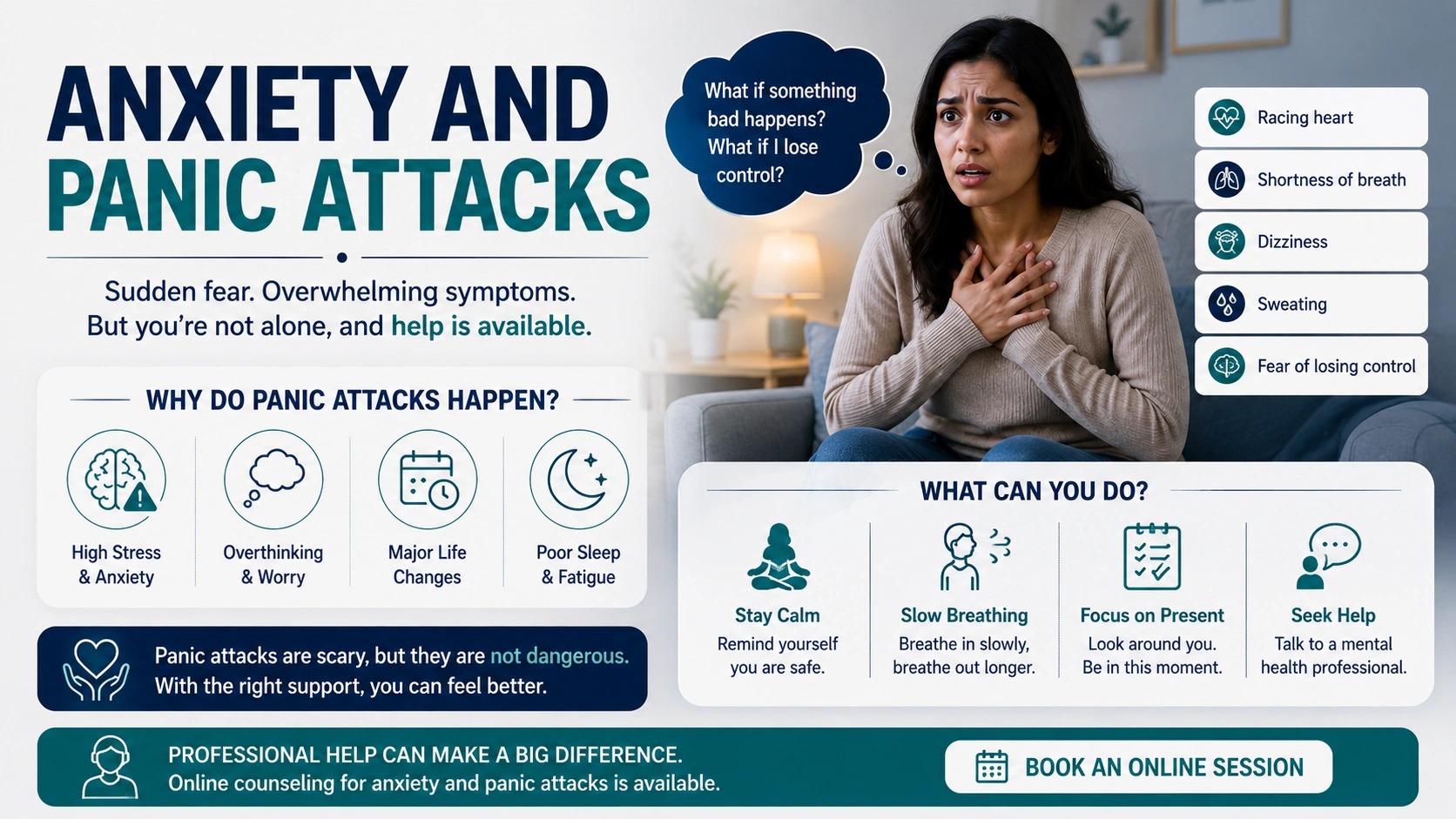
Have you ever suddenly felt your heart racing, your breathing becoming difficult, your body shaking, and a strong feeling that something terrible was about to happen?
Maybe you were completely fine a few minutes earlier.
Then suddenly, your body and mind seemed to go into “emergency mode.”
This can be frightening, especially when you don’t understand what’s happening.
Many people who experience panic attacks worry that they are having a heart attack, losing control, fainting, or facing some serious medical problem. After the episode passes, they may continue thinking about it and become afraid that it will happen again.
Panic attacks and anxiety are closely related, but they are not exactly the same thing.
Understanding the difference can make the experience less confusing and can help you decide when professional support may be appropriate.
What Is Anxiety?
Anxiety is a natural emotional response to stress, uncertainty, or a perceived threat.
For example, you may feel anxious before an interview, an exam, an important meeting, a difficult conversation, a major decision, or a medical appointment.
A certain amount of anxiety is normal.
The problem can arise when anxiety becomes frequent, intense, difficult to control, or starts interfering with everyday life.
You may find yourself constantly worrying about what could go wrong, even when there is no immediate danger.
What Is a Panic Attack?
A panic attack is a sudden episode of intense fear or discomfort that can come with strong physical and emotional symptoms.
It can happen during an obviously stressful situation, but it can also appear unexpectedly.
During a panic attack, someone may experience:
- Rapid heartbeat
- Sweating
- Shaking
- Shortness of breath
- Chest discomfort
- Dizziness
- Feeling hot or cold
- Nausea or stomach discomfort
- Feeling detached or unreal
- Fear of losing control
- Fear of dying
- A strong sense that something terrible is happening
The experience can feel extremely real and frightening.
Although panic symptoms can feel overwhelming, they do not automatically mean that something dangerous is happening.
However, new, severe, or unusual physical symptoms should not automatically be assumed to be a panic attack. Chest pain, severe breathing difficulty, fainting, or other concerning symptoms require appropriate medical evaluation.
What Is the Difference Between Anxiety and a Panic Attack?
Anxiety and panic attacks can overlap, but there are some important differences.
Anxiety
Anxiety often develops around a worry, threat, or stressful situation.
For example: “What if I fail my exam?” or “What if something goes wrong at work?”
The worry may continue for hours, days, or longer.
Panic Attack
A panic attack is generally more sudden and intense.
The symptoms may appear rapidly and can feel overwhelming.
Someone may suddenly think: “Something is seriously wrong with me.”
So, in simple terms: Anxiety is often associated with ongoing worry or fear, while a panic attack is a sudden surge of intense fear or discomfort. A person can experience both.
Why Do Panic Attacks Happen?
There isn’t always one obvious reason for a panic attack.
Different factors may contribute, including high levels of stress, anxiety, major life changes, fear of certain situations, previous panic experiences, ongoing emotional distress, sleep difficulties, certain substances or medications, and underlying physical or mental health conditions.
Sometimes a person experiences a panic attack without being able to identify an immediate trigger. That can make the experience even more confusing.
Can Anxiety Cause Panic Attacks?
Anxiety and panic attacks can be closely connected.
When anxiety remains high for a long period, the body may stay in a heightened state of alertness.
A person may become increasingly sensitive to physical sensations such as heartbeat, breathing, dizziness, or muscle tension. They may then interpret these sensations as dangerous.
For example: “My heart is beating fast” becomes “Something is wrong with my heart.”
That thought increases fear. The fear increases physical sensations. Those sensations create even more fear.
Physical Sensation → Fear → More Anxiety → Stronger Physical Sensation → More Fear
Understanding this cycle can be an important part of anxiety and panic treatment.

Common Symptoms of a Panic Attack
Panic attacks can affect both your body and your thoughts.
Physical Symptoms
You may experience a racing heart, sweating, trembling, shortness of breath, chest discomfort, dizziness, nausea, chills or hot sensations, tingling sensations, and muscle tension.
Psychological Symptoms
You may also experience intense fear, fear of dying, fear of losing control, fear of going crazy, feeling disconnected from yourself, feeling that your surroundings are unreal, and a strong urge to escape.
Not everyone experiences all of these symptoms.
Why Am I Afraid of Having Another Panic Attack?
One of the most difficult parts of panic attacks can be what happens after the attack.
You may start thinking: “What if it happens again?”
Then you might avoid places where you experienced the previous episode. For example, you may stop travelling alone, driving, going to crowded places, going to the gym, attending social events, or going far from home.
This can gradually reduce your confidence and increase anxiety. The fear of another panic attack can itself become part of the anxiety cycle.
Panic Attacks at Night
Some people experience panic-like episodes while trying to sleep or during the night.
You may suddenly wake up with a racing heartbeat, fear, sweating, shortness of breath, confusion, and a feeling that something is wrong.
Nighttime panic can be especially frightening because everything around you is quiet and you may not immediately understand what is happening.
If nighttime anxiety or panic is affecting your sleep repeatedly, discussing it with a mental health professional may be helpful. You can also read: Why Does Anxiety Get Worse at Night?
Panic Attacks and Overthinking
After experiencing a panic attack, you may spend a lot of time analyzing it. You may ask: “Why did it happen?”, “What if it happens again?”, “What if I faint?”, or “What if I can’t control myself?”
This kind of repetitive thinking can increase anxiety. The more you monitor your body and look for signs of another attack, the more noticeable normal physical sensations may become.
This is one reason learning to respond differently to anxious thoughts can be an important part of therapy.
What Should You Do During a Panic Attack?
If you believe you’re experiencing a panic attack, try to remind yourself that intense fear can create strong physical sensations.
You can try:
- Slow down: If possible, sit somewhere safe and allow yourself a moment to settle.
- Focus on the present: Notice what you can see, hear, and physically feel around you.
- Avoid repeatedly checking your symptoms: Constantly monitoring your heartbeat or searching symptoms online can sometimes increase fear.
- Remind yourself: You can tell yourself: “I’m experiencing intense anxiety right now. I can take this one moment at a time.”
However, if symptoms are new, severe, unusual, or you are unsure whether they are caused by anxiety, seek appropriate medical evaluation rather than assuming it’s a panic attack.
How Are Panic Attacks Treated?
Treatment depends on the individual’s symptoms and circumstances.
Psychological approaches may include Cognitive Behavioral Therapy (CBT), exposure-based approaches, anxiety counseling, relaxation strategies, mindfulness-based techniques, and other appropriate therapeutic approaches.
Therapy may focus on understanding the panic cycle, identifying triggers, working with fearful thoughts, reducing avoidance, and developing healthier coping strategies.
In some situations, psychiatric evaluation and medication may also be appropriate. A psychiatrist can determine whether medication is suitable based on a person’s medical and mental health needs.
Can Counseling Help With Panic Attacks?
Yes, counseling can help many people understand and manage anxiety and panic attacks and anxiety.
During counseling, you may explore what happens before an attack, what thoughts occur during an episode, how you interpret physical sensations, what situations you avoid, fear of having another attack, and stress and anxiety in your daily life.
The goal is not simply to tell yourself: “Don’t panic.” Instead, therapy can help you understand the pattern behind the panic and develop appropriate strategies for responding to it.
Can CBT Help With Panic Attacks?
Cognitive Behavioral Therapy (CBT) is commonly used to address anxiety and panic-related concerns.
CBT may help you identify unhelpful interpretations of physical sensations and fearful situations. For example: “My heart is beating fast, so something dangerous must be happening.”
Therapy may help you examine that interpretation and understand how anxiety itself can contribute to physical sensations.
Depending on the treatment plan, therapy may also address avoidance and fear of future panic attacks.
Can Panic Attacks Be Treated Online?
For many people, online anxiety counseling can be a convenient way to access psychological support.
You may prefer online counseling if you live in another city, have a busy schedule, prefer speaking from home, find travelling difficult, or feel more comfortable in a familiar environment.
An online session can provide a private space to discuss your anxiety, panic experiences, worries, and daily challenges. The suitability of online counseling depends on the individual’s circumstances and the level of support required.
When Should You Seek Professional Help?
You should consider talking to a mental health professional if panic attacks happen repeatedly, you constantly fear another attack, you avoid normal activities because of panic, anxiety is affecting your sleep or work/studies, you find it difficult to leave home, you constantly monitor physical sensations, worry is affecting your relationships, or you feel unable to manage anxiety on your own.
You don’t need to wait for panic attacks to become frequent before asking for help.

Online Anxiety & Panic Attack Counseling With Vaibhav Mishra
If you are experiencing recurring anxiety, panic attacks, fear of another attack, excessive worrying, or avoidance, professional support may help you understand what’s happening.
Vaibhav Mishra provides online mental health counseling, allowing you to discuss your concerns remotely from a comfortable environment.
Counseling may be useful for concerns related to anxiety, panic attacks, overthinking, excessive worrying, stress, fear-related concerns, sleep difficulties associated with anxiety, and emotional overwhelm.
You don’t need to diagnose yourself before reaching out. You can simply explain what you’ve been experiencing and discuss the support that may be appropriate for you.