
Anxiety Therapy: Types and Approaches That Can Help
Anxiety is something almost everyone experiences at some point in life. Feeling nervous before an important meeting, exam, interview, or difficult conversation is normal.
But sometimes anxiety becomes more than temporary nervousness.
You may find yourself worrying about things repeatedly, imagining the worst possible outcome, avoiding situations you used to handle easily, or lying awake at night because your mind won’t slow down.
When anxiety starts affecting your sleep, relationships, work, studies, or everyday life, you may start wondering:
“Can therapy actually help with anxiety?”
The answer is that psychological therapy can be helpful for many people experiencing anxiety. But there isn’t one single type of anxiety therapy that works exactly the same way for everyone.
Different therapeutic approaches focus on different aspects of anxiety. A mental health professional can help you understand your concerns and determine which approach may be appropriate for your situation.
In this article, we’ll look at the different types of anxiety treatment, how they work, what you can expect from counseling, and how online anxiety counseling may help.
What Is Anxiety Therapy?
Anxiety therapy refers to psychological treatment approaches used to help people understand and manage anxiety, excessive worry, fear, and related emotional or behavioral difficulties.
Therapy isn’t simply about telling someone: “Don’t worry.”
If it were that easy, most people would already have solved their anxiety.
Instead, therapy may help you understand:
- Why certain situations trigger anxiety
- Why particular thoughts keep repeating
- How anxiety affects your behavior
- Why you may avoid certain situations
- How your body responds to stress
- What keeps the anxiety cycle going
- How you can develop healthier ways of responding
The approach depends on your individual concerns, symptoms, goals, and circumstances.
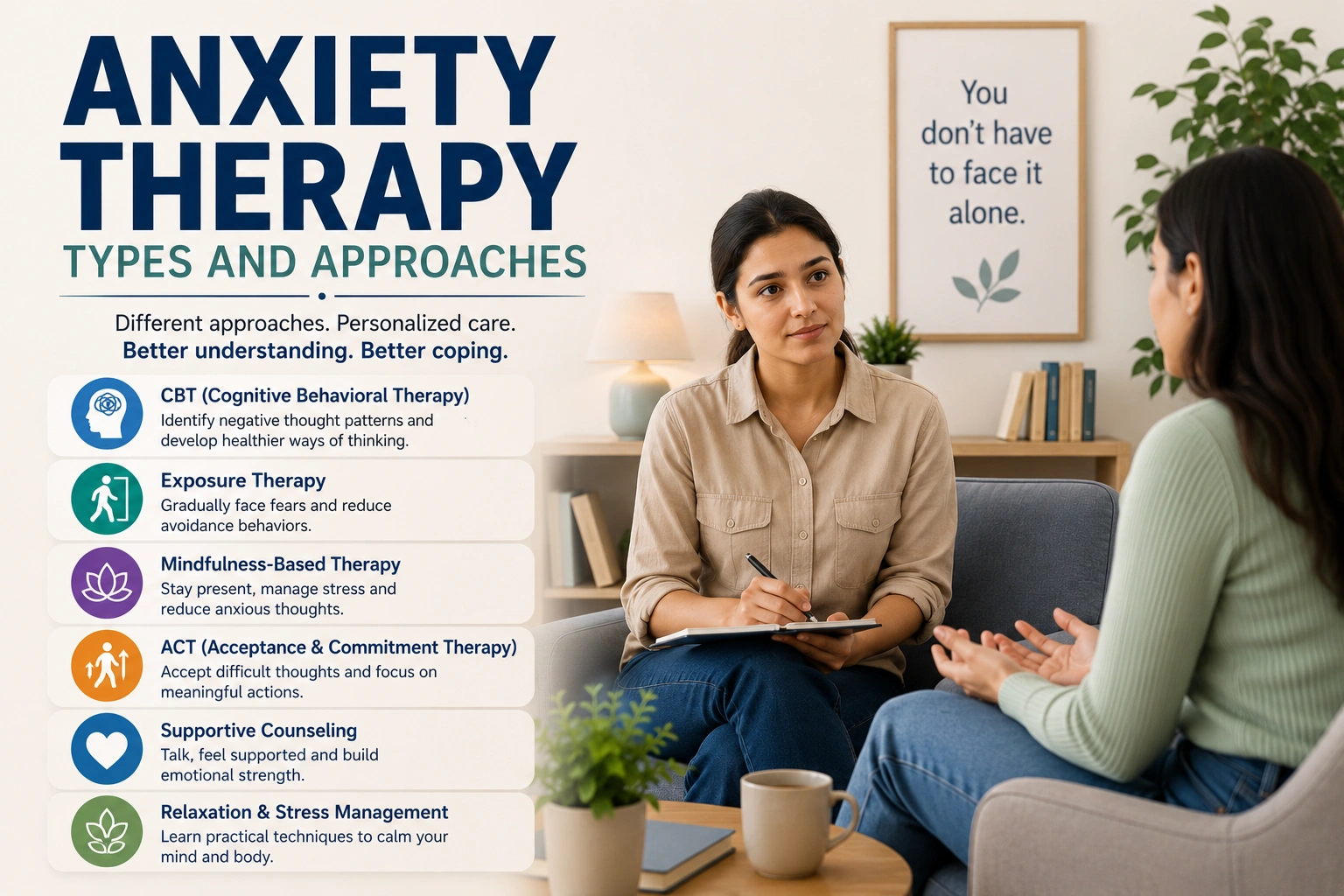
What Are the Different Types of Anxiety Therapy?
Several psychological approaches may be used when working with anxiety.
Some of the commonly used approaches include:
- Cognitive Behavioral Therapy (CBT)
- Exposure-based approaches
- Mindfulness-based approaches
- Acceptance and Commitment Therapy (ACT)
- Supportive counseling
- Relaxation and stress-management strategies
Not every approach is appropriate for every person.
A qualified mental health professional can help determine what may fit your situation.

1. Cognitive Behavioral Therapy (CBT) for Anxiety
Cognitive Behavioral Therapy, commonly known as CBT, is one of the most widely used psychological approaches for anxiety.
CBT looks at the connection between:
Thoughts → Feelings → Behaviors
For example, imagine someone has to speak in front of a group.
They may think: “Everyone is going to judge me.”
That thought may create fear and physical tension.
Because they feel anxious, they may decide to avoid speaking altogether.
Avoiding the situation provides temporary relief, but the person may become even more afraid of similar situations in the future.
CBT can help people identify these patterns and learn different ways of thinking and responding.
How CBT May Help With Anxiety
CBT may involve working on:
- Unhelpful thinking patterns
- Excessive worry
- Fear-based assumptions
- Avoidance behaviors
- Problem-solving
- Emotional responses
- Practical coping strategies
The goal isn’t to replace every negative thought with an unrealistically positive thought.
Instead, therapy can help you develop a more balanced and realistic way of looking at difficult situations.
2. Exposure-Based Therapy
Anxiety can sometimes make people avoid situations that they fear.
For example:
- Someone with social anxiety may avoid parties.
- Someone with a fear of driving may avoid driving.
- Someone with panic-related concerns may avoid places where they previously experienced intense anxiety.
Avoidance can feel helpful in the short term because it reduces anxiety temporarily.
However, it can sometimes strengthen the fear over time.
Exposure-based approaches involve gradually working with feared situations in a structured and appropriate way.
The process should be personalized and should not mean suddenly forcing yourself into an overwhelming situation.
Instead, therapy can help you gradually develop confidence and learn that anxiety can be managed.
3. Mindfulness-Based Approaches
Sometimes anxiety keeps your attention stuck in the past or future.
You may repeatedly think:
- “What if this happens?”
- “What if I made a mistake?”
- “What will happen tomorrow?”
- “What if something goes wrong?”
Mindfulness-based approaches can help develop greater awareness of the present moment.
Rather than automatically reacting to every anxious thought, you can learn to notice thoughts and emotions with greater awareness.
Mindfulness strategies may include:
- Paying attention to the present moment
- Observing thoughts without immediately reacting
- Breathing exercises
- Body awareness
- Relaxation practices
These techniques can be useful as part of a broader anxiety-management plan.
4. Acceptance and Commitment Therapy (ACT)
Acceptance and Commitment Therapy, or ACT, takes a somewhat different approach to difficult thoughts and emotions.
Instead of making the goal: “I must get rid of every anxious thought.”
ACT can focus on learning how to respond differently to difficult thoughts and feelings while continuing to take meaningful actions based on your values.
For example, you may feel anxious about meeting new people but still want meaningful friendships.
Therapy may help you understand the anxiety while gradually taking actions that are important to you.
5. Supportive Counseling
Sometimes a person doesn’t immediately need a highly structured therapeutic approach.
They may first need a safe place where they can talk openly about what’s happening in their life.
Supportive counseling can provide space to discuss stress, relationships, work pressure, family concerns, life changes, emotional difficulties, and worry and anxiety.
A counselor can listen, help you understand your situation, and support you in developing healthier ways of coping.
The approach can be adapted according to the person’s needs.
6. Relaxation and Stress-Management Techniques
Anxiety can affect the body as well as the mind.
You might experience muscle tension, restlessness, fast heartbeat, sweating, difficulty relaxing, trouble sleeping, and feeling constantly “on edge”.
Depending on your situation, counseling may include relaxation and stress-management strategies like breathing exercises, grounding techniques, relaxation exercises, mindfulness, healthy routines, and stress-management strategies.
These tools can be useful, but they aren’t necessarily a complete treatment for persistent or severe anxiety.
Which Anxiety Therapy Is Best?
This is one of the most common questions people ask.
The honest answer is: There isn’t one anxiety therapy that is best for everyone.
The right approach can depend on your type of anxiety, severity of symptoms, how long you’ve experienced anxiety, personal circumstances, treatment goals, previous experiences with therapy, and your response to treatment.
For example, someone struggling mainly with excessive worry may have different needs from someone experiencing panic attacks or social anxiety.
That’s why personalized assessment and treatment planning are important.
What Happens During Anxiety Therapy?
You may be nervous about your first session, especially if you’ve never spoken to a counselor before. That’s completely understandable.
Usually, the first conversation is about understanding what you’re going through. Your counselor may ask about what brings you to counseling, when your anxiety started, what situations trigger it, how frequently you experience it, how it affects your daily life, sleep, relationships, work/academic stress, previous experiences, and what you hope to achieve.
You don’t have to explain everything perfectly. You can simply start with: “I’ve been feeling anxious lately and I don’t know how to manage it.” That’s enough to begin the conversation.

Can Anxiety Therapy Help With Overthinking?
Yes, overthinking and anxiety often go together.
You may replay conversations in your head, worry about future situations, think about things you cannot control, or repeatedly search for reassurance.
Therapy can help you understand this pattern and develop healthier ways of responding to repetitive worry. You can also read our detailed guide: How to Stop Overthinking and Anxiety.
Can Anxiety Therapy Help With Panic Attacks?
Anxiety therapy may also be useful for people experiencing panic attacks and anxiety.
A person may experience symptoms such as sudden intense fear, racing heartbeat, shortness of breath, sweating, shaking, dizziness, feeling out of control, and fear that something terrible is happening.
Because some physical symptoms of panic can overlap with medical conditions, new, severe, or concerning physical symptoms should not automatically be assumed to be anxiety. Appropriate medical evaluation may be necessary. Therapy can then address the psychological and behavioral aspects of panic when appropriate.
Can Anxiety Therapy Help With Social Anxiety?
Social anxiety can make ordinary social situations feel extremely difficult. You may worry about being judged, making mistakes, speaking in front of others, meeting new people, talking to coworkers, attending social events, and being embarrassed.
Therapy can help you understand the thoughts and behaviors associated with social anxiety and, when appropriate, gradually work toward facing situations that you have been avoiding.
How Long Does Anxiety Therapy Take?
There is no fixed number of sessions. Some people may benefit from relatively short-term therapy, while others may need longer-term support.
The duration can depend on your symptoms, type of anxiety, severity, personal circumstances, treatment goals, and progress during therapy.
Instead of asking only “How many sessions will I need?”, it can be more useful to look at whether you’re gradually becoming better able to manage anxiety and participate in your everyday life.
Is Anxiety Therapy Different From Anxiety Counseling?
The terms counseling and therapy are sometimes used interchangeably, although their exact meaning can vary depending on professional training and context.
Both can involve talking with a mental health professional about emotional and psychological concerns. For anxiety, the important thing is not simply the label. What matters is the professional’s qualifications, their scope of practice, therapeutic approach, your individual needs, and whether the approach is appropriate for your concerns.
Can Anxiety Therapy Be Done Online?
Yes. Online anxiety counseling can be a convenient option for people who prefer to speak with a mental health professional remotely.
You may choose online counseling if you live in another city, prefer speaking from home, have a busy schedule, find travelling difficult, feel more comfortable in a familiar environment, or want a convenient way to start counseling.
Is Online Anxiety Counseling Right for You?
Online counseling can work well for many people, but it isn’t suitable for every situation.
If you’re dealing with ongoing anxiety, excessive worry, stress, overthinking, or related emotional concerns, an initial conversation with an appropriately qualified professional can help determine what type of support may be suitable.
If someone is experiencing an immediate mental health crisis or is at risk of harming themselves or someone else, urgent local emergency or medical support should be sought instead of waiting for a routine online counseling session.
What Can You Do Between Anxiety Therapy Sessions?
Therapy doesn’t only happen during the session. Depending on your treatment plan, you may benefit from practicing certain skills between sessions, such as noticing anxiety triggers, keeping track of recurring thought patterns, practicing relaxation techniques, following a healthier sleep routine, gradually working on avoidance behaviors, and making time for physical activity.
Your counselor can guide you regarding which strategies are appropriate for you.
When Should You Consider Anxiety Therapy?
Consider speaking with a mental health professional if anxiety is difficult to control, affects your sleep, interferes with work or studies, affects your relationships, causes significant distress, leads you to avoid everyday activities, is accompanied by frequent panic-like experiences, makes it difficult to concentrate, or has continued for a prolonged period.
You don’t need to wait until anxiety completely takes over your life. Sometimes getting support earlier can make it easier to understand what’s happening and decide what to do next.

Online Anxiety Counseling With Vaibhav Mishra
If anxiety, excessive worrying, overthinking, stress, or fear is affecting your everyday life, online anxiety counseling can provide a convenient way to talk with a mental health professional from your preferred location.
At Vaibhav Mishra, online counseling focuses on understanding your individual concerns and working toward practical strategies that fit your situation.
You can discuss concerns related to anxiety, excessive worrying, overthinking, stress, panic-related concerns, sleep difficulties associated with anxiety, emotional overwhelm, and relationship-related concerns.
You Don’t Have to Figure Everything Out Alone
You don’t need to know exactly which type of therapy you need before your first session. You can simply explain what you’ve been experiencing. From there, a mental health professional can help you understand your concerns and discuss appropriate support options.